






















Los Artículos sobre Mascotas (Perros o Gatos) de PETSmania
Ir a indice de Artículos
Kerry Blue Terrier
Degerative Mielopaty (DM) Kerry Blue Terrier
Por :
Ávila (España)
Seccion:
DEGENERATIVE MIELOPATY (D.M.)
Breed
All The Breeds.
Disease
Degerative Mielopaty (DM) is an important neurodegerative disease which starts at an old age around 8 years of age. The disease is produced by a degeneration of the axons and of the myelin in the thoracic and sacrum of the spinal cord which produces progressive ataxia and paralysis. The first clinic symptom to appear is in the back legs as a sign of an alteration of the upper motor neurons. As the disease advances the uncoordinated movements appear in the back legs, alterations in the perception and in the reflexes. In an advanced state the front legs will be also affected with paralysis. This disease was discovered at the first time in German Sheppard as a spinal cord disease, but as with this breed, this disease has been found in many others.
A Mutation has been found as the main cause of risk to suffer this disease, but depending on the age it will have in incomplete penetrance.
Mutation and Herebality
The fault responsible of the mutation of the gene SOD1 can be identified by a DNA test.
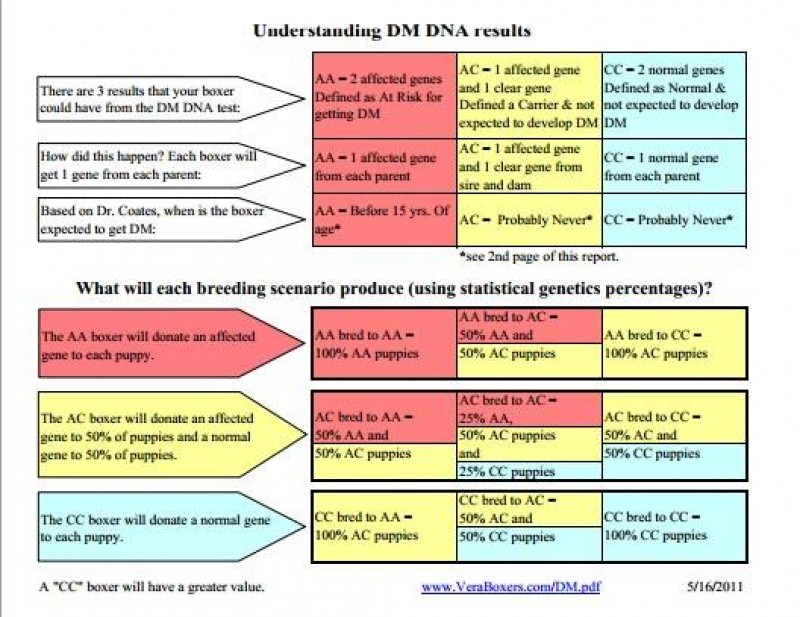
DM is inherited in an autosomal recessive way with uncomplete penetrance. This means that a dog will only get ill when he obtains an affected gen from both: father and mother. That is why the father and the mother must have the mutated gene to suffer the disease. Carriers, which are animals with only one mutated gene, will never suffer the disease of DM, but will transmit this mutated gene to their offspring in a 50% of probabilities. In the mate of two Carriers, the risk of affected animals is clear. This is the reason for not mating two Carriers.
There are Three Genotypes:
1. Genotype N/N (Free Homocygous): This dog does not carry the mutation and has no risk to get ill of D.M. It cannot transmit the mutation to its offspring. This dog is Free of the mutation.
2. Genotype N/DM (Carrier Homocygous): This dog carries a copy of the mutated gene and also a copy of a free gene. He has no risk to get ill fo D.M. but it will transmit the affected gene to its offspring in a 50% of probabilities. This dog must only be mated to a free mutated gene. This dog is a Carrier.
3. Genotype DM/DM (Affected Homocygous): This dog carries two copies of the mutated gene and has a high risk of probabilities to get ill of DM. It will transmit the mutation to all its offspring in a 100% of probabilities and must be only mated to a free mutated gene dog. This dog is Affected.
The DNA Test
A DNA test gives the possibility of a clear identification of the mutation. The DNA test is independent of the animal’s age and can also be done on puppies. It will not only make the difference among affected animals, but will also give us information about the Carriers which is of maximum importance for the Breeding.
To guarantee the highest security of the test, every test is done two times in an individual way.
Material
1ml of blood with EDTA or an oral smear.
Time for the Test
1 week
Method
PCR in real time
Notes
The test can be done by oral smear. The necessary swabs for this test will be provided and posted in a free way by LABOKLIN. It is very important that the simple is done in the correct way, or it will not drag enough material for the test.
The test will be done several times a week. The result will be ready in 1 week or so after the sample arrives to the Lab.
For more information, contact us:
Dra. Petra Kühnlein, Dra. Ines Langbein-Detsch o Dr. Miguel Galián
LABOKLIN GmbH und Co.KG
Steubenstraße 4
D-97688 Bad Kissingen, Alemania
Phone: +49-971/72020 o Fax: +49-971/ 7202995

LA CADIERA Caniche Enano y Caniche Toy

cc lacadiera.com
Paraje de la Puente Grande, s.n.
Berrocalejo de Aragona
5194 - Ávila - España
Mov: +34-693.801.910
cc
lacadiera.comParaje de la Puente Grande, s.n.
Berrocalejo de Aragona
5194 - Ávila - España
Mov: +34-693.801.910
Nota: no se responsabiliza de la informacion u opiniones vertidas en estos contenidos ni tiene por que estar de acuerdo con ellos.


Artículos publicados: 692
Mostrando la pagina 22 de 47
Mostrando la pagina 22 de 47
Mis niños los 3 Fs.
Seccion: Mis preciosos Querubines han nacido felizmente !!! Todos sanos y fuertes. Son 4 chicos y una princesita ! ...
Rhodesian Ridgeback
LA FORMACIÓN Y LA IMPORTANCIA DEL DERMOID SINUS
Seccion: LA FORMACIÓN Y LA IMPORTANCIA DEL DERMOID SINUS
El Rhodesian Ridgeback es una raza relativamente moderna creada a finales del siglo diecinueve, mediante el cruce de los perros indígenas Hotentotes con algunas razas europeas llevadas a El Cabo por los prime ...
Por : MOLEMA Mua Rôo
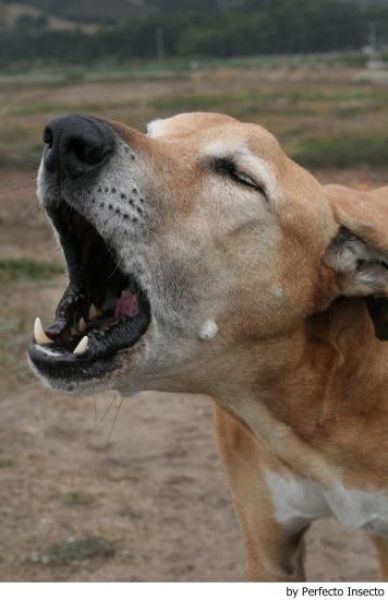
Miedo a las personas
Seccion: El miedo es una de las características psíquicas que conforman el carácter de un perro, que deben ser tenidas más en cuenta de cara a una convivencia apacible y duradera de éstos con las personas. ...
Por : ETOLOGIA VETERINARIA
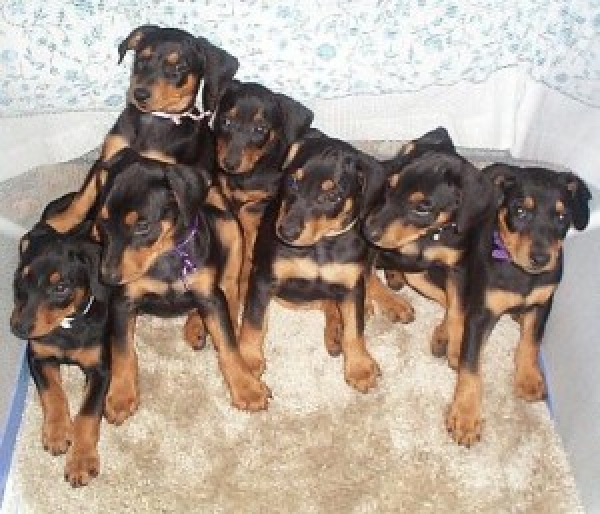
Pinscher Miniatura
Las Patologías y Pruebas en el Pinscher Miniatura
Seccion: Las Patologías y Pruebas en el Pinscher Miniatura
Muchas pruebas de estas patologías pueden ser transmitidas genéticamente o pueden aparecer sin más en el perro. Cada patología o prueba se realiza de manera diferente, desde una radiografía, un análisis ...
Por : MINI PINSCHER
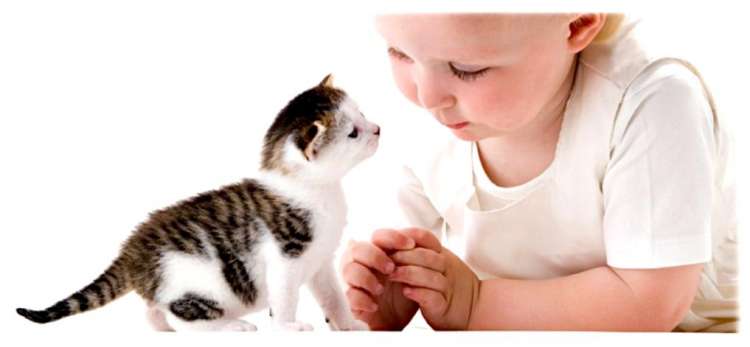
Zoonosis. Enfermedades transmisibles a las personas
Seccion: Hoy en día el tema de las zoonosis (las enfermedades transmitidas de los animales a las personas) está a la orden del día. ...
La Pseudogestación
Seccion: La pseudogestación es lo que coloquialmente y entre los neófitos se da por llamar embarazo psicológico Sin embargo no es nada psicológico, sino que es una condición o estado fisiológico y, por lo tant ...
Por : ETOLOGIA VETERINARIA
El cuidado dental del perro
Seccion: La persistencia de dientes de leche, la poliodoncia (dientes supernumerarios) y la oligodoncia (falta de dientes) son las tres anomalías genéticas dentarias que diagnosticamos con más frecuencia. ...
Mi mascota tiene mal aliento...
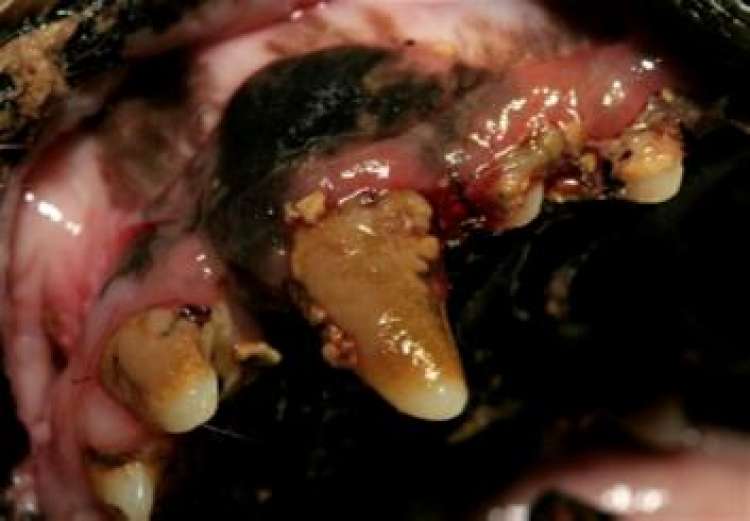
Seccion: Las alteraciones bucodentales son el problema más frecuente en perros y gatos ya que se calcula que más del 80% de los perros y el 70% de los gatos mayores de 3 años presentan signos de enfermedad dental sie ...
Antiguo Perro de Pastor Inglés
EL CARÁCTER DEL BOBTAIL
Seccion: EL CARÁCTER DEL BOBTAIL
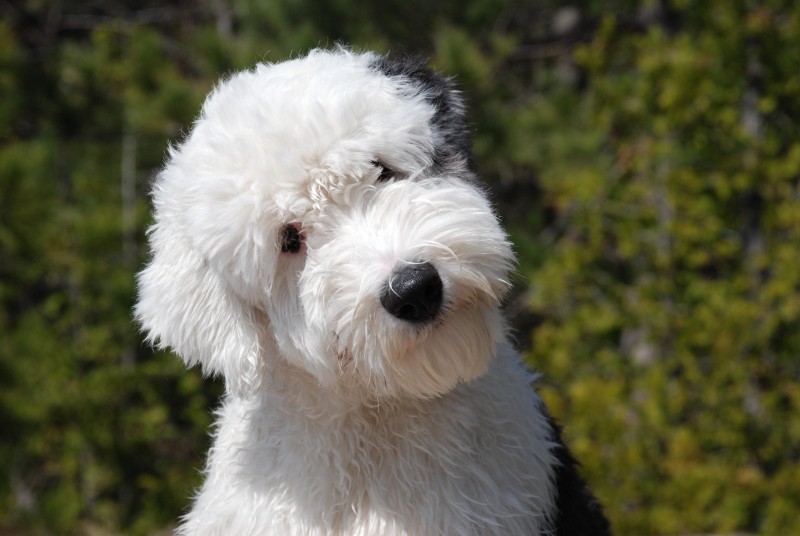
Es complicado entender el carácter del Bobtail sin haberlo disfrutado antes. Incluso habiendo tenido el placer de disfrutar de la compañía de un perro de cualquier otra raza ...
Por : DEL JOWERS
¿ Qué es la Leishmaniosis ?
Seccion: Es una grave enfermedad producida por un parásito llamado Leishmania, transmitida por un tipo concreto de mosquito que se llama Flebotomus o mosca de arena. ...
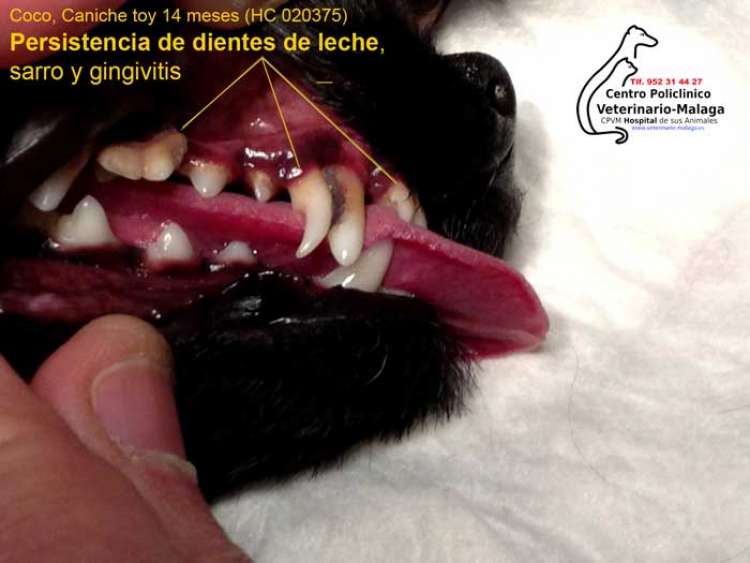
Dientes de leche persistentes y dientes supernumerarios
Seccion: La persistencia de los dientes de leche y la poliodoncia o dientes supernumerarios son dos de las enfermedades odontológicas mas habituales en la clínica de perros de razas pequeñas ...
Enfermedades infecciosas del perro ¿por qué y de qué los vacunamos?
Seccion: Seis son las enfermedades infecciosas víricas más habituales del perro y de las que normalmente se les vacuna para prevenir su contagio: moquillo, parvovirosis, hepatitis, leptospirosis, tos de las perreras ...
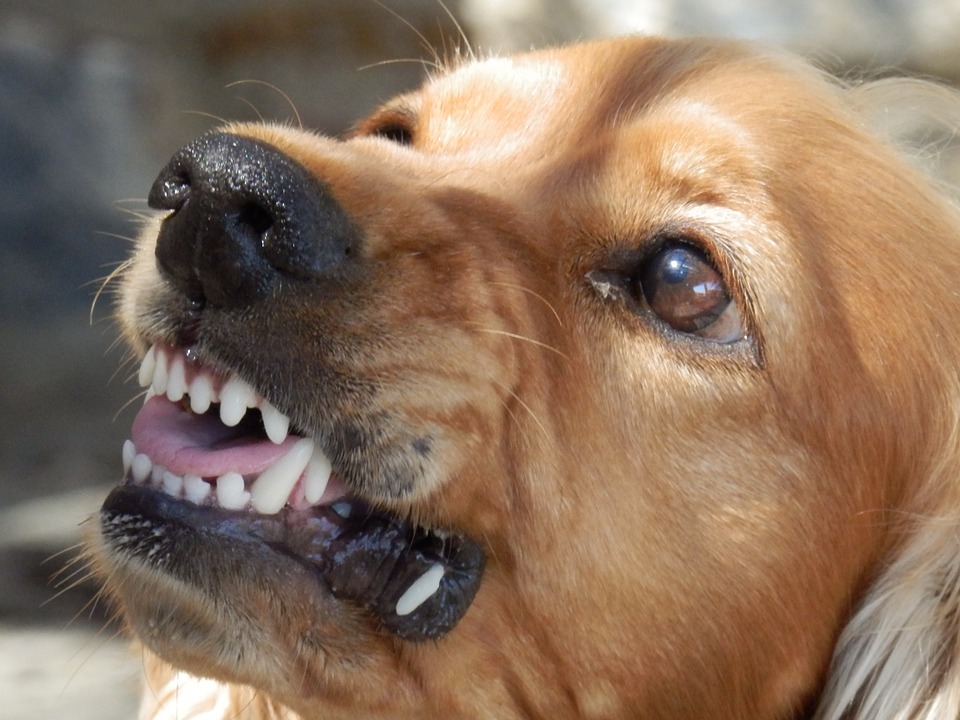
La inhibición de la mordida
Seccion: La inhibición de la mordida es una de las enseñanzas que se producen en la especie canina, por parte de la madre hacia los cachorros ...
Por : ETOLOGIA VETERINARIA
Border Collie
Patologías en el Border Collie
Seccion: Patologías en el Border Collie
El Border Collie es una raza sana pero, como cualquier otra raza, tiene predisposición a padecer ciertas patologías. Nuestra preocupación por el bienestar y la salud de nuestros perros y de los futuros c ...
Por : LOS TRASTOLILLOS